Mark Twain the Man Who Does Not Read Meaning
 2nd (1st U.s.a.) edition book comprehend | |
| Author | Mark Twain |
|---|---|
| Illustrator | E. W. Kemble |
| State | United states of america |
| Language | English language |
| Series | Tom Sawyer |
| Genre | Picaresque novel |
| Publisher | Chatto & Windus / Charles L. Webster And Company. |
| Publication date | December 10, 1884 (UK and Canada) 1885[one] (United states of america) |
| Pages | 366 |
| OCLC | 29489461 |
| Preceded by | The Adventures of Tom Sawyer |
| Followed by | Tom Sawyer Abroad |
| Text | Adventures of Huckleberry Finn at Wikisource |
Adventures of Huckleberry Finn or every bit it is known in more contempo editions, The Adventures of Huckleberry Finn , is a novel by American author Marker Twain, which was kickoff published in the Uk in December 1884 and in the United States in Feb 1885.
Unremarkably named among the Great American Novels, the work is among the outset in major American literature to be written throughout in vernacular English, characterized by local colour regionalism. Information technology is told in the first person past Huckleberry "Huck" Finn, the narrator of two other Twain novels (Tom Sawyer Abroad and Tom Sawyer, Detective) and a friend of Tom Sawyer. Information technology is a straight sequel to The Adventures of Tom Sawyer.
The book is noted for "changing the course of children's literature" in the United states of america for the "securely felt portrayal of boyhood".[2] It is also known for its colorful description of people and places forth the Mississippi River. Set in a Southern antebellum social club that had ceased to exist over 20 years earlier the piece of work was published, Adventures of Blueberry Finn is an oftentimes scathing satire on entrenched attitudes, peculiarly racism.
Perennially pop with readers, Adventures of Huckleberry Finn has likewise been the continued object of study by literary critics since its publication. The book was widely criticized upon release because of its extensive use of coarse language. Throughout the 20th century, and despite arguments that the protagonist and the tenor of the book are anti-racist,[3] [4] criticism of the book connected due to both its perceived use of racial stereotypes and its frequent utilise of the racial slur "nigger".
Characters [edit]
In order of advent:
- Tom Sawyer is Huck's best friend and peer, the main grapheme of other Twain novels and the leader of the boondocks boys in adventures. He is mischievous, good hearted, and "the best fighter and the smartest kid in boondocks".[5]
- Blueberry Finn, "Huck" to his friends, is a male child about "13 or 14 or along there" years erstwhile. (Chapter 17) He has been brought upward by his male parent, the town drunk, and has a difficult time fitting into society. In the novel, Huck'south skillful nature offers a dissimilarity to the inadequacies and inequalities in order.
- Widow Douglas is the kind woman who takes Huck in after he helped save her from a vehement domicile invasion. She tries her best to civilize Huck, believing it is her Christian duty.
- Miss Watson is the widow's sister, a tough old spinster who too lives with them. She is fairly difficult on Huck, causing him to resent her a skilful deal. Mark Twain may have drawn inspiration for this character from several people he knew in his life.[five]
- Jim is Miss Watson's physically large just mild-mannered slave. Huck becomes very close to Jim when they reunite after Jim flees Miss Watson'due south household to seek refuge from slavery, and Huck and Jim go fellow travelers on the Mississippi River.
- "Pap" Finn, Huck's father, a brutal alcoholic out-of-stater. He resents Huck getting any kind of education. His simply 18-carat involvement in his son involves begging or extorting money to feed his alcohol addiction.
- Judith Loftus plays a small role in the novel — being the kind and perceptive woman whom Huck talks to in social club to find out about the search for Jim — but many critics believe her to be the best drawn female character in the novel.[five]
- The Grangerfords, an aloof Kentuckian family headed by the sexagenarian Colonel Saul Grangerford, take Huck in after he is separated from Jim on the Mississippi. Huck becomes close friends with the youngest male person of the family, Buck Grangerford, who is Huck'due south historic period. By the time Huck meets them, the Grangerfords take been engaged in an historic period-old claret feud with another local family, the Shepherdsons.
- The Duke and the King are two otherwise unnamed con artists whom Huck and Jim have aboard their raft just before the start of their Arkansas adventures. They pose as the long-lost Duke of Bridgewater and the long-dead Louis XVII of France in an attempt to over-awe Huck and Jim, who quickly come up to recognize them for what they are, just cynically pretend to accept their claims to avoid conflict.
- Doctor Robinson is the only man who recognizes that the King and Knuckles are phonies when they pretend to be British. He warns the townspeople, but they ignore him.
- Mary Jane, Joanna, and Susan Wilks are the three young nieces of their wealthy guardian, Peter Wilks, who has recently died. The Duke and the King try to steal their inheritance past posing as Peter's estranged brothers from England.
- Aunt Sally and Uncle Silas Phelps buy Jim from the Duke and the King. She is a loving, high-strung "farmer's wife", and he a plodding old man, both a farmer and a preacher. Huck poses as their nephew Tom Sawyer subsequently he parts from the conmen.
Plot summary [edit]

Blueberry Finn, as depicted by E. W. Kemble in the original 1884 edition of the volume
In Missouri [edit]
The story begins in fictional St. Petersburg, Missouri (based on the actual town of Hannibal, Missouri), on the shore of the Mississippi River "xl to 50 years ago" (the novel having been published in 1884). Blueberry "Huck" Finn (the protagonist and starting time-person narrator) and his friend, Thomas "Tom" Sawyer, have each come into a considerable sum of money as a result of their earlier adventures (detailed in The Adventures of Tom Sawyer). Huck explains how he is placed under the guardianship of the Widow Douglas, who, together with her stringent sis, Miss Watson, are attempting to "sivilize" him and teach him religion. Huck finds civilized life confining. His spirits are raised when Tom Sawyer helps him to slip past Miss Watson's slave, Jim, and so he tin can meet up with Tom'southward gang of cocky-proclaimed "robbers". Simply as the gang'southward activities begin to bore Huck, his shiftless father, "Pap", an abusive alcoholic, suddenly reappears. Huck, who knows his father will spend the money on alcohol, is successful at keeping his fortune out of his father'south hands. Pap, however, kidnaps Huck and takes him out of boondocks.
In Illinois, Jackson's Island and while going Downriver [edit]
Pap forcibly moves Huck to an abased cabin in the woods along the Illinois shoreline. To evade farther violence and escape imprisonment, Huck elaborately fakes his own murder, steals his begetter'due south provisions, and sets off downriver in a 13/14-foot long canoe he finds drifting downstream. Before long, he settles comfortably on Jackson's Isle, where he reunites with Jim, Miss Watson's slave. Jim has besides run abroad after he overheard Miss Watson planning to sell him "downwards the river" to presumably more brutal owners. Jim plans to make his mode to the town of Cairo in Illinois, a free state, then that he can afterward purchase the rest of his enslaved family's liberty. At showtime, Huck is conflicted near the sin and crime of supporting a delinquent slave, but as the two talk in-depth and bail over their mutually held superstitions, Huck emotionally connects with Jim, who increasingly becomes Huck'due south close friend and guardian. After heavy flooding on the river, the two discover a raft (which they continue) equally well equally an entire house floating on the river (Chapter 9: "The House of Death Floats By"). Inbound the house to seek loot, Jim finds the naked body of a dead human being lying on the floor, shot in the back. He prevents Huck from viewing the corpse.[6]
To discover out the latest news in town, Huck dresses as a girl and enters the house of Judith Loftus, a adult female new to the area. Huck learns from her about the news of his own supposed murder; Pap was initially blamed, only since Jim ran away he is besides a doubtable and a reward of 300 dollars for Jim's capture has initiated a manhunt. Mrs. Loftus becomes increasingly suspicious that Huck is a male child, finally proving it by a series of tests. Huck develops another story on the fly and explains his disguise as the only way to escape from an abusive foster family unit. Once he is exposed, she however allows him to leave her abode without commotion, not realizing that he is the allegedly murdered boy they accept but been discussing. Huck returns to Jim to tell him the news and that a search party is coming to Jackson's Island that very night. The two hastily load upward the raft and depart.
After a while, Huck and Jim come across a grounded steamer. Searching it, they stumble upon 2 thieves named Bill and Jake Packard discussing murdering a third named Jim Turner, merely they flee earlier being noticed in the thieves' boat as their raft has drifted away. They find their own raft again and keep the thieves' loot and sink the thieves' boat. Huck tricks a watchman on a steamer into going to rescue the thieves stranded on the wreck to assuage his conscience. They are later separated in a fog, making Jim (on the raft) intensely anxious, and when they reunite, Huck tricks Jim into thinking he dreamed the entire incident. Jim is not deceived for long and is deeply injure that his friend should accept teased him and then mercilessly. Huck becomes remorseful and apologizes to Jim, though his conscience troubles him well-nigh humbling himself to a Black man.
In Kentucky: the Grangerfords and Shepherdsons [edit]
Traveling onward, Huck and Jim'southward raft is struck past a passing steamship, again separating the two. Huck is given shelter on the Kentucky side of the river by the Grangerfords, an "aristocratic" family. He befriends Buck Grangerford, a boy about his age, and learns that the Grangerfords are engaged in a thirty-year blood feud confronting another family, the Shepherdsons. Although Huck asks Buck why the feud started in the first place, he is told no i knows anymore. The Grangerfords and Shepherdsons become to the same church, which ironically preaches brotherly dear. The vendetta finally comes to a caput when Cadet's older sister elopes with a fellow member of the Shepherdson clan. In the resulting conflict, all the Grangerford males from this branch of the family are shot and killed by the remaining Shepherdsons — including Buck, whose horrific murder Huck witnesses. He is immensely relieved to exist reunited with Jim, who has since recovered and repaired the raft.
In Arkansas: the Duke and the King [edit]
Well-nigh the Arkansas-Missouri-Tennessee border, Jim and Huck have ii on-the-run grifters aboard the raft. The younger man, who is about thirty, introduces himself as the long-lost son of an English language knuckles (the Knuckles of Bridgewater). The older 1, nearly seventy, and then trumps this outrageous claim by alleging that he himself is the Lost Dauphin, the son of Louis Xvi and rightful King of France. The "duke" and "male monarch" before long become permanent passengers on Jim and Huck's raft, committing a serial of confidence schemes upon unsuspecting locals all along their journey. To divert public suspicion from Jim, they pretend he is a runaway slave who has been recaptured, merely later paint him blue and call him the "Sick Arab" so that he can move about the raft without bindings.
On 1 occasion, the swindlers annunciate a three-night engagement of a play chosen "The Royal Nonesuch". The play turns out to exist simply a couple of minutes' worth of an absurd, earthy sham. On the afternoon of the kickoff performance, a drunk chosen Boggs is shot dead by a gentleman named Colonel Sherburn; a lynch mob forms to retaliate confronting Sherburn; and Sherburn, surrounded at his domicile, disperses the mob by making a defiant spoken language describing how true lynching should be washed. By the tertiary night of "The Royal Nonesuch", the townspeople fix for their revenge on the knuckles and king for their money-making scam, only the 2 cleverly skip town together with Huck and Jim simply before the performance begins.
In the next town, the two swindlers then impersonate brothers of Peter Wilks, a recently deceased man of property. To match accounts of Wilks's brothers, the king attempts an English accent and the duke pretends to be a deaf-mute while starting to collect Wilks's inheritance. Huck decides that Wilks's three orphaned nieces, who care for Huck with kindness, do not deserve to be cheated thus and so he tries to recall for them the stolen inheritance. In a drastic moment, Huck is forced to hide the money in Wilks's coffin, which is abruptly buried the side by side morning time. The arrival of two new men who seem to be the real brothers throws everything into confusion, and so that the townspeople determine to dig up the coffin in gild to decide which are the truthful brothers, but, with everyone else distracted, Huck leaves for the raft, hoping to never see the knuckles and king again. Suddenly, though, the two villains return, much to Huck's despair. When Huck is finally able to get away a 2nd time, he finds to his horror that the swindlers accept sold Jim abroad to a family that intends to return him to his proper owner for the reward. Defying his censor and accepting the negative religious consequences he expects for his actions—"All right, then, I'll go to hell!"—Huck resolves to costless Jim once and for all.
On the Phelpses' farm [edit]
Huck learns that Jim is being held at the plantation of Silas and Sally Phelps. The family'due south nephew, Tom, is expected for a visit at the same time as Huck's arrival, and then Huck is mistaken for Tom and welcomed into their home. He plays along, hoping to find Jim'southward location and free him; in a surprising plot twist, information technology is revealed that the expected nephew is, in fact, Tom Sawyer. When Huck intercepts the real Tom Sawyer on the road and tells him everything, Tom decides to join Huck'south scheme, pretending to be his ain younger half-brother, Sid, while Huck continues pretending to be Tom. In the concurrently, Jim has told the family unit about the two grifters and the new program for "The Imperial Nonesuch", then the townspeople capture the duke and male monarch, who are then tarred and feathered and ridden out of boondocks on a rail.
Rather than just sneaking Jim out of the shed where he is beingness held, Tom develops an elaborate plan to free him, involving secret messages, a hidden tunnel, snakes in a shed, a rope ladder sent in Jim'south food, and other elements from run a risk books he has read,[7] including an anonymous note to the Phelps warning them of the whole scheme. During the bodily escape and resulting pursuit, Tom is shot in the leg, while Jim remains by his side, risking recapture rather than completing his escape lonely. Although a local doctor admires Jim'due south decency, he has Jim arrested in his sleep and returned to the Phelpses. Afterward this, events speedily resolve themselves. Tom'due south Aunt Polly arrives and reveals Huck and Tom'southward true identities to the Phelps family unit. Jim is revealed to be a free homo: Miss Watson died two months earlier and freed Jim in her volition, but Tom (who already knew this) chose not to reveal this data to Huck so that he could come up up with an artful rescue plan for Jim. Jim tells Huck that Huck'south male parent (Pap Finn) has been dead for some fourth dimension (he was the dead homo they found earlier in the floating business firm), and so Huck may at present return safely to St. Petersburg. Huck declares that he is quite glad to be done writing his story, and despite Emerge'due south plans to prefer and civilize him, he intends to flee westward to Indian Territory.
Theme [edit]
Adventures of Huckleberry Finn explores themes of race and identity. A complexity exists apropos Jim's character. While some scholars point out that Jim is expert-hearted and moral, and he is not unintelligent (in dissimilarity to several of the more than negatively depicted white characters), others have criticized the novel equally racist, citing the employ of the word "nigger" and emphasizing the stereotypically "comic" handling of Jim's lack of didactics, superstition and ignorance.[8] [9]
Throughout the story, Huck is in moral conflict with the received values of the guild in which he lives. Huck is unable consciously to rebut those values even in his thoughts just he makes a moral option based on his own valuation of Jim's friendship and human being worth, a decision in direct opposition to the things he has been taught. Twain, in his lecture notes, proposes that "a sound eye is a surer guide than an sick-trained censor" and goes on to draw the novel as "...a book of mine where a sound eye and a deformed conscience come into collision and conscience suffers defeat".[10]
To highlight the hypocrisy required to condone slavery within an ostensibly moral system, Twain has Huck'southward begetter enslave his son, isolate him and trounce him. When Huck escapes, he immediately encounters Jim "illegally" doing the same thing. The treatments both of them receive are radically different, specially in an run into with Mrs. Judith Loftus who takes pity on who she presumes to be a delinquent amateur, Huck, nonetheless boasts about her hubby sending the hounds later a runaway slave, Jim.[11]
Some scholars discuss Huck's own character, and the novel itself, in the context of its relation to African-American civilisation as a whole. John Alberti quotes Shelley Fisher Fishkin, who writes in her 1990s book Was Huck Black?: Mark Twain and African-American Voices, "by limiting their field of inquiry to the periphery," white scholars "have missed the means in which African-American voices shaped Twain'south artistic imagination at its core." It is suggested that the character of Blueberry Finn illustrates the correlation, and even interrelatedness, betwixt white and Black culture in the U.s.a..[12]
Illustrations [edit]
The original illustrations were done by East.W. Kemble, at the time a young creative person working for Life magazine. Kemble was mitt-picked by Twain, who admired his piece of work. Hearn suggests that Twain and Kemble had a like skill, writing that:
Whatever he may accept lacked in technical grace ... Kemble shared with the greatest illustrators the power to give fifty-fifty the modest individual in a text his own singled-out visual personality; just equally Twain so deftly defined a full-rounded graphic symbol in a few phrases, so besides did Kemble depict with a few strokes of his pen that aforementioned unabridged personage.[13]
As Kemble could afford only ane model, most of his illustrations produced for the volume were done by guesswork. When the novel was published, the illustrations were praised fifty-fifty equally the novel was harshly criticized. E.W. Kemble produced another gear up of illustrations for Harper'south and the American Publishing Visitor in 1898 and 1899 after Twain lost the copyright.[14]
Publication's effect on literary climate [edit]

Twain initially conceived of the work every bit a sequel to The Adventures of Tom Sawyer that would follow Huckleberry Finn through machismo. Beginning with a few pages he had removed from the before novel, Twain began work on a manuscript he originally titled Blueberry Finn's Autobiography. Twain worked on the manuscript off and on for the next several years, ultimately abandoning his original plan of following Huck's development into adulthood. He appeared to have lost interest in the manuscript while it was in progress, and set it aside for several years. After making a trip down the Hudson River, Twain returned to his work on the novel. Upon completion, the novel's title closely paralleled its predecessor's: Adventures of Huckleberry Finn (Tom Sawyer'southward Comrade).[fifteen]
Mark Twain composed the story in pen on notepaper between 1876 and 1883. Paul Needham, who supervised the authentication of the manuscript for Sotheby'southward books and manuscripts section in New York in 1991, stated, "What you see is [Clemens'] attempt to move away from pure literary writing to dialect writing". For instance, Twain revised the opening line of Huck Finn three times. He initially wrote, "You lot will not know about me", which he changed to, "You do not know nigh me", earlier settling on the concluding version, "You don't know about me, without you have read a book past the proper noun of 'The Adventures of Tom Sawyer'; but that own't no affair."[sixteen] The revisions also prove how Twain reworked his material to strengthen the characters of Huck and Jim, as well as his sensitivity to the then-current debate over literacy and voting.[17] [18]
A later version was the first typewritten manuscript delivered to a printer.[xix]
Demand for the book spread outside of the The states. Adventures of Huckleberry Finn was eventually published on December 10, 1884, in Canada and the United Kingdom, and on February 18, 1885, in the Usa.[20] The analogy on page 283 became a point of issue after an engraver, whose identity was never discovered, made a last-minute addition to the printing plate of Kemble'due south movie of onetime Silas Phelps, which drew attention to Phelps' groin. Thirty k copies of the book had been printed before the obscenity was discovered. A new plate was made to correct the illustration and repair the existing copies.[21] [22]
In 1885, the Buffalo Public Library'due south curator, James Fraser Gluck, approached Twain to donate the manuscript to the library. Twain did and then. Later it was believed that half of the pages had been misplaced by the printer. In 1991, the missing starting time half turned up in a steamer trunk owned past descendants of Gluck'due south. The library successfully claimed possession and, in 1994, opened the Mark Twain Room to showcase the treasure.[23]
In relation to the literary climate at the time of the book'southward publication in 1885, Henry Nash Smith describes the importance of Mark Twain'south already established reputation equally a "professional humorist", having already published over a dozen other works. Smith suggests that while the "dismantling of the decadent Romanticism of the subsequently nineteenth century was a necessary performance," Adventures of Huckleberry Finn illustrated "previously inaccessible resources of imaginative power, but also made vernacular language, with its new sources of pleasure and new free energy, bachelor for American prose and poetry in the twentieth century."[24]
Critical reception and banning [edit]
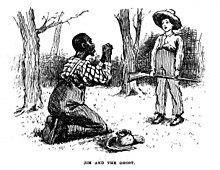
In this scene illustrated by Eastward. Due west. Kemble, Jim has given Huck up for dead and when he reappears thinks he must be a ghost.
While it is articulate that Adventures of Huckleberry Finn was controversial from the commencement, Norman Mailer, writing in The New York Times in 1984, ended that Twain's novel was not initially "too unpleasantly regarded." In fact, Mailer writes: "the critical climate could hardly conceptualize T. South. Eliot and Ernest Hemingway's encomiums fifty years afterward," reviews that would remain longstanding in the American consciousness.[25]
Alberti suggests that the academic establishment responded to the book's challenges both dismissively and with confusion. During Twain's time and today, defenders of Adventures of Huckleberry Finn "lump all nonacademic critics of the book together as extremists and 'censors', thus equating the complaints about the book's 'coarseness' from the genteel bourgeois trustees of the Agree Public Library in the 1880s with more contempo objections based on race and civil rights."[12]
Upon issue of the American edition in 1885, several libraries banned it from their shelves.[26] The early criticism focused on what was perceived equally the book'southward crudeness. One incident was recounted in the newspaper the Boston Transcript:
The Concur (Mass.) Public Library committee has decided to exclude Mark Twain'south latest book from the library. One member of the committee says that, while he does non wish to call it immoral, he thinks it contains only trivial humor, and that of a very coarse type. He regards it as the veriest trash. The library and the other members of the commission entertain similar views, characterizing it as crude, coarse, and inelegant, dealing with a series of experiences not elevating, the whole book existence more suited to the slums than to intelligent, respectable people.[27]
Writer Louisa May Alcott criticized the book'southward publication as well, proverb that if Twain "[could non] remember of something better to tell our pure-minded lads and lasses he had best stop writing for them".[28] [29]
Twain later on remarked to his editor, "Apparently, the Concord library has condemned Huck every bit 'trash and only suitable for the slums.' This will sell united states of america some other twenty-five thousand copies for sure!"
In 1905, New York'southward Brooklyn Public Library also banned the book due to "bad word option" and Huck's having "not only itched but scratched" inside the novel, which was considered obscene. When asked past a Brooklyn librarian almost the state of affairs, Twain sardonically replied:
I am greatly troubled by what you say. I wrote 'Tom Sawyer' & 'Huck Finn' for adults exclusively, & it always distressed me when I find that boys and girls have been allowed access to them. The heed that becomes soiled in youth can never once more be washed clean. I know this past my ain experience, & to this 24-hour interval I cherish an unappeased bitterness against the unfaithful guardians of my young life, who not only permitted just compelled me to read an unexpurgated Bible through before I was 15 years erstwhile. None can exercise that and ever draw a clean sweet breath again on this side of the grave.[30]
Many subsequent critics, Ernest Hemingway among them, take deprecated the final capacity, challenge the book "devolves into fiddling more than than minstrel-prove satire and broad one-act" after Jim is detained.[31] Although Hemingway alleged, "All modern American literature comes from" Huck Finn, and hailed it as "the best volume nosotros've had", he cautioned, "If you must read it you must cease where the Nigger Jim is stolen from the boys [sic]. That is the real end. The rest is just cheating."[32] [33] The African-American author Ralph Ellison argued that "Hemingway missed completely the structural, symbolic and moral necessity for that role of the plot in which the boys rescue Jim. Yet information technology is precisely this part which gives the novel its significance."[34] Pulitzer Prize winner Ron Powers states in his Twain biography (Mark Twain: A Life) that "Huckleberry Finn endures as a consensus masterpiece despite these final capacity", in which Tom Sawyer leads Huck through elaborate machinations to rescue Jim.[35]
Controversy [edit]
In his introduction to The Annotated Blueberry Finn, Michael Patrick Hearn writes that Twain "could be uninhibitedly vulgar", and quotes critic William Dean Howells, a Twain contemporary, who wrote that the writer'southward "humor was not for about women". Notwithstanding, Hearn continues by explaining that "the reticent Howells constitute zip in the proofs of Blueberry Finn so offensive that information technology needed to be struck out".[36]
Much of modernistic scholarship of Huckleberry Finn has focused on its treatment of race. Many Twain scholars have argued that the volume, by humanizing Jim and exposing the fallacies of the racist assumptions of slavery, is an attack on racism.[37] Others have argued that the volume falls short on this score, especially in its depiction of Jim.[26] According to Professor Stephen Railton of the University of Virginia, Twain was unable to fully ascension above the stereotypes of Black people that white readers of his era expected and enjoyed, and, therefore, resorted to minstrel bear witness-mode comedy to provide sense of humour at Jim'south expense, and ended up confirming rather than challenging late-19th century racist stereotypes.[38]
In one case, the controversy caused a drastically altered interpretation of the text: in 1955, CBS tried to avoid controversial material in a televised version of the book, past deleting all mention of slavery and omitting the character of Jim entirely.[39]
Because of this controversy over whether Huckleberry Finn is racist or anti-racist, and considering the discussion "nigger" is often used in the novel (a commonly used discussion in Twain's fourth dimension that has since go vulgar and taboo), many take questioned the appropriateness of educational activity the book in the U.Southward. public school organization—this questioning of the word "nigger" is illustrated by a school administrator of Virginia in 1982 calling the novel the "nearly grotesque instance of racism I've always seen in my life".[40] According to the American Library Association, Huckleberry Finn was the fifth most often challenged book in the United states during the 1990s.[41]
There have been several more than recent cases involving protests for the banning of the novel. In 2003, high school student Calista Phair and her grandmother, Beatrice Clark, in Renton, Washington, proposed banning the volume from classroom learning in the Renton Schoolhouse District, though not from any public libraries, considering of the word "nigger". The two curriculum committees that considered her request eventually decided to keep the novel on the 11th grade curriculum, though they suspended information technology until a panel had fourth dimension to review the novel and set a specific teaching process for the novel's controversial topics.[42]
In 2009, a Washington country high schoolhouse teacher, John Foley, called for replacing Adventures of Blueberry Finn with a more modern novel.[43] In an opinion column that Foley wrote in the Seattle Post Intelligencer, he states that all "novels that use the 'N-give-and-take' repeatedly demand to get." He states that education the novel is not only unnecessary, but difficult due to the offensive language within the novel with many students becoming uncomfortable at "just hear[ing] the N-give-and-take."[44]
In 2016, Adventures of Huckleberry Finn was removed from a public school district in Virginia, along with the novel To Kill a Mockingbird, due to their use of racial slurs.[45] [46]
Expurgated editions [edit]
Publishers have made their ain attempts at easing the controversy past way of releasing editions of the book with the word "nigger" replaced past less controversial words. A 2011 edition of the book, published by NewSouth Books, employed the word "slave" (although the discussion is not properly applied to a freed homo). Their argument for making the change was to offer the reader a choice of reading a "sanitized" version if they were not comfortable with the original.[47] Mark Twain scholar Alan Gribben said he hoped the edition would be more than friendly for utilise in classrooms, rather than accept the work banned outright from classroom reading lists due to its linguistic communication.[48]
According to publisher Suzanne La Rosa, "At NewSouth, we saw the value in an edition that would aid the works discover new readers. If the publication sparks skilful debate about how language impacts learning or about the nature of censorship or the way in which racial slurs practice their baneful influence, and then our mission in publishing this new edition of Twain'southward works will be more than emphatically fulfilled."[49] Another scholar, Thomas Wortham, criticized the changes, maxim the new edition "doesn't claiming children to ask, 'Why would a child like Huck use such reprehensible language?'"[50]
Adaptations [edit]
Movie [edit]
- Huck and Tom (1918 silent) by Famous Players-Lasky; directed past William Desmond Taylor; starring Jack Pickford equally Tom, Robert Gordon as Huck and Clara Horton as Becky[51]
- Huckleberry Finn (1920 silent) past Famous Players-Lasky; directed by William Desmond Taylor; starring Lewis Sargent every bit Huck, Gordon Griffith as Tom and Thelma Salter as Becky[52] [53]
- Huckleberry Finn (1931) by Paramount Pictures; directed by Norman Taurog; starring Jackie Coogan as Tom, Junior Durkin equally Huck, and Mitzi Green as Becky[53] [54]
- The Adventures of Huckleberry Finn (1939) by MGM; directed by Richard Thorpe; starring Mickey Rooney every bit Huck[55]
- The Adventures of Blueberry Finn (1955), starring Thomas Mitchell and John Carradine[56]
- The Adventures of Huckleberry Finn (1960), directed by Michael Curtiz, starring Eddie Hodges and Archie Moore[57]
- Hopelessly Lost (1973), a Soviet film[58]
- Huckleberry Finn (1974), a musical film[59]
- Blueberry Finn (1975), an ABC movie of the week with Ron Howard every bit Huck Finn[60]
- The Adventures of Con Sawyer and Hucklemary Finn (1985), an ABC movie of the week with Drew Barrymore as Con Sawyer[61]
- The Adventures of Huck Finn (1993), starring Elijah Wood and Courtney B. Vance[62]
- Tom and Huck (1995), starring Jonathan Taylor Thomas as Tom and Brad Renfro every bit Huck[63]
- Tomato Sawyer and Huckleberry Larry'southward Big River Rescue (2008), a VeggieTales parody[64]
- The Adventures of Huck Finn (2012), a German film starring Leon Seidel and directed by Hermine Huntgeburth[65]
- Tom Sawyer & Huckleberry Finn (2014), starring Joel Courtney as Tom Sawyer, Jake T. Austin as Huckleberry Finn, Katherine McNamara every bit Becky Thatcher[66]
Television [edit]
- Huckleberry no Bōken, a 1976 Japanese anime with 26 episodes[67]
- Huckleberry Finn and His Friends, a 1979 series starring Ian Tracey[68]
- Adventures of Blueberry Finn, a 1985 PBS TV adaptation directed past Peter H. Hunt, starring Patrick Day and Samm-Art Williams.
- Huckleberry Finn Monogatari (ハックルベリー・フィン物語), a 1994 Japanese anime with 26 episodes, produced by NHK[69]
Other [edit]
- The Adventures of Huckleberry Finn (1973), by Robert James Dixson – a simplified version[seventy]
- Large River: The Adventures of Huckleberry Finn, a 1985 Broadway musical with lyrics and music by Roger Miller[71]
- Manga Classics: Adventures of Huckleberry Finn published by UDON Amusement'south Manga Classics banner was released in November 2017.[72]
[edit]
Literature [edit]
- Finn: A Novel (2007), by Jon Clinch – a novel near Huck's father, Pap Finn (ISBN 0812977149)
- Huck Out Westward (2017), by Robert Coover – continues Huck'south and Tom's adventures during the 1860s and 1870s (ISBN 0393608441)
- The Further Adventures of Huckleberry Finn (1983) past Greg Matthews – continues Huck's and Jim's adventures every bit they "light out for the territory" and wind upward in the throes of the California Gold Rush of 1849[73] [74] [75] [76]
- My Jim (2005), by Nancy Rawles – a novel narrated largely by Sadie, Jim's enslaved wife (ISBN 140005401X)
Music [edit]
- Mississippi Suite (1926), by Ferde Grofe: the second motility is a lighthearted whimsical piece entitled "Huckleberry Finn"[77]
- Huckleberry Finn EP (2009), comprising v songs from Kurt Weill's unfinished musical, by Duke Special[78]
Television [edit]
- The New Adventures of Huckleberry Finn, a 1968 children's series produced past Hanna-Barbera combining live-action and animation[79]
See also [edit]
- Mark Twain bibliography
- List of films featuring slavery
- The Story of a Bad Male child
Footnotes [edit]
- ^ Adventures of Huckleberry Finn (Tom Sawyer'south comrade)…. 1885.
- ^ "Adventures of Blueberry Finn | Summary & Characters". Encyclopedia Britannica . Retrieved August half-dozen, 2021.
- ^ Twain, Mark (Oct 1885). Adventures of Huckleberry Finn (Tom Sawyer's comrade).... ... - Full View – HathiTrust Digital Library – HathiTrust Digital Library. HathiTrust.
- ^ Jacob O'Leary, "Critical Annotation of "Minstrel Shackles and Nineteenth Century 'Liberality' in Huckleberry Finn" (Fredrick Woodard and Donnarae MacCann)," Wiki Service, University of Iowa, concluding modified February 11, 2012, accessed April 12, 2012 Archived March 12, 2011, at the Wayback Auto
- ^ a b c Loma, Richard (2002). Marking Twain Amid The Scholars: Reconsidering Contemporary Twain Criticism. SJK Publishing Industries, Inc. pp. 67–ninety. ISBN978-0-87875-527-1.
- ^ Ira Fistell (2012). Ira Fistell's Mark Twain: Three Encounters. Xlibris. ISBN 9781469178721 p. 94. "Huck and Jim's showtime adventure together—the Business firm of Death incident which occupies Chapter 9. This sequence seems to me to be quite important both to the technical performance of the plot and to the larger meaning of the novel. The Firm of Death is a 2-story frame edifice that comes floating downstream, i paragraph after Huck and Jim catch their soon—to—exist famous raft. While Twain never explicitly says then, his description of the house and its contents ..."
- ^ Victor A. Doyno (1991). Writing Huck Finn: Mark Twain's creative process. University of Pennsylvania Press. p. 191. ISBN9780812214482.
- ^ 2. Jacob O'Leary, "Disquisitional Annotation of "Minstrel Shackles and Nineteenth Century 'Liberality' in Huckleberry Finn" (Fredrick Woodard and Donnarae MacCann)," Wiki Service, University of Iowa, last modified February 11, 2012, accessed April 12, 2012 Archived March 12, 2011, at the Wayback Machine
- ^ Fredrick Woodard and Donnarae MacCann, "Minstrel Shackles and Nineteenth Century "Liberality" in Huckleberry Finn," in Satire or evasion?: Black perspectives on Huckleberry Finn, eds. James Southward. Leonard, Thomas A. Tenney, and Thadious M. Davis (Durham, NC: Knuckles University Printing, 1992).
- ^ Marking Twain (1895). Notebook No. 35. Typescript, P. 35. Marker Twain Papers. Bancroft Library, Academy of California, Berkeley.
- ^ Foley, Barbara (1995). "Reviewed work: Satire or Evasion? Black Perspectives on Huckleberry Finn, James South. Leonard, Thomas A. Tenney, Thadious Davis; the Word in Black and White: Reading "Race" in American Literature, 1638-1867, Dana D. Nelson". Modern Philology. 92 (3): 379–385. doi:x.1086/392258. JSTOR 438790.
- ^ a b Alberti, John (1995). "The Nigger Huck: Race, Identity, and the Teaching of Huckleberry Finn". College English. 57 (8): 919–937. doi:10.2307/378621. JSTOR 378621.
- ^ Twain, Marking (Samuel Fifty. Clemens) (2001). The Annotated Huckleberry Finn : Adventures of Huckleberry Finn (Tom Sawyer's comrade). Introduction, notes, and bibliography by Michael Patrick Hearn (1st ed.). New York, NY [u.a.]: Norton. pp. xlv–xlvi. ISBN978-0-393-02039-seven.
- ^ Cope, Virginia H. "Marker Twain's Blueberry Finn: Text, Illustrations, and Early on Reviews". Academy of Virginia Library. Archived from the original on January 17, 2013. Retrieved December 17, 2012.
- ^ Mark Twain and Michael Patrick Hearn, The Annotated Huckleberry Finn: Adventures of Huckleberry Finn (New York: Clarkson Northward. Potter, 1981).
- ^ Philip Young, Ernest Hemingway: A Afterthought, (University Park: Pennsylvania Land Up, 1966), 212.
- ^ Bakery, William (1996). "Reviewed work: Adventures of Huckleberry Finn, Mark Twain". The Antioch Review. 54 (3): 363–364. doi:x.2307/4613362. hdl:2027/dul1.ark:/13960/t1sf9415m. JSTOR 4613362.
- ^ "Rita Reif, "First One-half of 'Huck Finn,' in Twain's Hand, Is Constitute," The New York Times, last modified February 17, 1991, accessed April 12, 2012".
- ^ William Baker, "Adventures of Blueberry Finn past Marking Twain"
- ^ McCrum, Robert (February 24, 2014). "The 100 all-time novels: No 23 – The Adventures of Huckleberry Finn past Marker Twain (1884/five)". The Guardian. London. Retrieved Dec 9, 2019.
- ^ Walter Blair, Marker Twain & Huck Finn (Berkeley: Academy of California, 1960).
- ^ "All Modern Literature Comes from One Volume past Mark Twain"
- ^ "Rita Reif, "ANTIQUES; How 'Huck Finn' Was Rescued," The New York Times, final modified March 17, 1991, accessed Apr 12, 2012".
- ^ Smith, Henry Nash; Finn, Blueberry (1984). "The Publication of "Huckleberry Finn": A Centennial Hindsight". Bulletin of the American Academy of Arts and Sciences. 37 (5): 18–40. doi:10.2307/3823856. JSTOR 3823856.
- ^ "Norman Mailer, "Huckleberry Finn, Live at 100," The New York Times, last modified December nine, 1984, accessed Apr 12, 2012".
- ^ a b Leonard, James S.; Thomas A. Tenney; Thadious G. Davis (December 1992). Satire or Evasion?: Black Perspectives on Blueberry Finn. Duke Academy Printing. p. ii. ISBN978-0-8223-1174-4.
- ^ Shelley Fisher Fishkin, "Was Huck Blackness?: Mark Twain and African-American Voices" (New York: Oxford UP, 1993) 115.
- ^ Chocolate-brown, Robert. "One Hundred Years of Huck Finn". American Heritage Magazine. AmericanHeritage.com. Archived from the original on Jan nineteen, 2010. Retrieved November 8, 2010.
If Mr. Clemens cannot remember of something ameliorate to tell our pure-minded lads and lasses he had best stop writing for them.
- ^ "1 Hundred Years Of Huck Finn – AMERICAN HERITAGE". www.americanheritage.com.
- ^ "Marjorie Kehe, "The 'n'-discussion Gone from Huck Finn – What Would Mark Twain Say? A New Expurgated Edition of 'Huckleberry Finn' Has Got Some Twain Scholars up in Artillery," The Christian Science Monitor, last modified Jan 5, 2011, accessed Apr 12, 2012".
- ^ "Nick Gillespie, "Mark Twain vs. Tom Sawyer: The Bold Deconstruction of a National Icon," Reason, last modified Feb 2006, accessed Apr 12, 2012".
- ^ Ernest Hemingway (1935). Dark-green Hills of Africa . New York: Scribner. p. 22.
- ^ Norman Mailer, "Huckleberry Finn, Live at 100"
- ^ "Twentieth Century Fiction and the Mask of Humanity" in Shadow and Act
- ^ Ron Powers (2005). Marking Twain: A Life . New York: FreePress. pp. 476–77.
- ^ Mark Twain and Michael Patrick Hearn, 8.
- ^ For example, Shelley Fisher Fishin, Lighting out for the Territory: Reflections on Mark Twain and American Culture (New York: Oxford Academy Press, 1997).
- ^ "Stephen Railton, "Jim and Mark Twain: What Exercise Dey Stan' For?," The Virginia Quarterly Review, last modified 1987, accessed April 12, 2012".
- ^ Alex Abrupt, "Pupil Edition of Huck Finn and Tom Sawyer Is Censored by Editor"
- ^ Robert B. Brown, "1 Hundred Years of Huck Finn"
- ^ "100 well-nigh frequently challenged books: 1990–1999". March 27, 2013.
- ^ "Gregory Roberts, "'Huck Finn' a Masterpiece -- or an Insult," Seattle Post-Intelligencer, terminal modified November 25, 2003, accessed April 12, 2012".
- ^ "Wash. teacher calls for 'Huck Finn' ban". UPI. Jan nineteen, 2009.
- ^ "John Foley, "Guest Columnist: Fourth dimension to Update Schools' Reading Lists," Seattle Mail-Intelligencer, final modified Jan 5, 2009, accessed April 13, 2012".
- ^ Allen, Nick (December 5, 2016). "To Kill a Mockingbird and Huckleberry Finn banned from schools in Virginia for racism". Telegraph . Retrieved December 29, 2016.
- ^ "Books suspended past Va. school for racial slurs". CBS News. December ane, 2016. Retrieved Dec 29, 2016.
- ^ ""Huckleberry Finn" and the N-word contend". world wide web.cbsnews.com . Retrieved August 6, 2021.
- ^ "New Edition Of 'Huckleberry Finn' Will Eliminate Offensive Words". NPR.org. Jan 4, 2011.
- ^ "A give-and-take nigh the NewSouth edition of Mark Twain's Tom Sawyer and Blueberry Finn – NewSouth Books".
- ^ ""New Editions of Mark Twain Novels to Remove Racial Slurs," Herald Dominicus, last modified Jan 4, 2011, accessed April 16, 2012". Archived from the original on April 21, 2016. Retrieved Jan 4, 2011.
- ^ Huck and Tom at the American Film Plant Catalog
- ^ "IMDB, Huckleberry Finn (1920)".
- ^ a b wes-connors (February 29, 1920). "Huckleberry Finn (1920)". IMDb.
- ^ "IMDB, Blueberry Finn (1931)".
- ^ The Adventures of Huckleberry Finn at the American Film Institute Catalog
- ^ The Adventures of Huckleberry Finn at IMDb
- ^ The Adventures of Huckleberry Finn at the American Film Institute Catalog
- ^ Hopelessly Lost at AllMovie
- ^ Huckleberry Finn at the TCM Motion-picture show Database
- ^ Huckleberry Finn at IMDb
- ^ The Adventures of Con Sawyer and Hucklemary Finn at the TCM Movie Database
- ^ The Adventures of Huck Finn at AllMovie
- ^ Tom and Huck at AllMovie
- ^ Tomato Sawyer and Huckleberry Larry's Big River Rescue at IMDb
- ^ The Adventures of Huckleberry Finn at IMDb
- ^ Tom Sawyer & Huckleberry Finn at IMDb
- ^ Huckleberry no Bōken (anime) at Anime News Network'southward encyclopedia
- ^ Huckleberry Finn and His Friends at IMDb
- ^ Huckleberry Finn Monogatari (anime) at Anime News Network's encyclopedia
- ^ The Adventures of Huckleberry Finn in libraries (WorldCat catalog)
- ^ Large River at the Internet Broadway Database
- ^ Manga Classics: Adventures of Huckleberry Finn (2017) UDON Entertainment ISBN 978-1772940176
- ^ Matthews, Greg (May 28, 1983). The Further Adventures of Huckleberry Finn. Crown Publishers. ISBN9780517550571 – via Google Books.
- ^ "LeClair, Tom. "A Reconstruction and a Sequel." Sunday Volume Review, The New York Times, September 25, 1983".
- ^ "Kirby, David. "Energetic Sequel to 'Huckleberry Finn' is True-blue to Original." The Christian Science Monitor, October eleven, 1983".
- ^ "Kirkus Review: The Further Adventures of Blueberry Finn by Greg Matthews. Kirkus, September 9, 1983".
- ^ Ledin, Victor and Marina A. "GROFE: Grand Canyon Suite / Mississippi Suite / Niagara Falls". Naxos Records. Retrieved Dec eight, 2017.
- ^ "Huckleberry Finn EP". Duke Special. Retrieved December 8, 2017.
- ^ The New Adventures of Blueberry Finn at IMDb
Further reading [edit]
- Beaver, Harold, et al., eds. "The Role of Structure in Tom Sawyer and Huckleberry Finn." Huckleberry Finn. Vol. ane. No. viii. (New York: Johns Hopkins Textual Studies, 1987) pp. 1–57.
- Brown, Clarence A. "Blueberry Finn: A Written report in Construction and Point of View." Mark Twain Periodical 12.2 (1964): x-fifteen. Online
- Buchen, Callista. "Writing the Imperial Question at Home: Huck Finn and Tom Sawyer Among the Indians Revisited." Mark Twain Annual ix (2011): 111-129. online
- Gribben, Alan. "Tom Sawyer, Tom Canty, and Huckleberry Finn: The Male child Book and Mark Twain." Mark Twain Periodical 55.one/2 (2017): 127-144 online
- Levy, Andrew, Huck Finn'southward America: Mark Twain and the Era that Shaped His Masterpiece. New York: Simon and Schuster, 2015.
- Quirk, Tom. "The Flawed Greatness of Huckleberry Finn." American Literary Realism 45.ane (2012): 38-48.
- Saunders, George. "The United states of Huck: Introduction to Adventures of Huckleberry Finn." In Adventures of Blueberry Finn (Modernistic Library Classics, 2001) ISBN 978-0375757372, reprinted in Saunders, George, The Braindead Megaphone: Essays (New York: Riverhead Books, 2007) ISBN 978-1-59448-256-4
- Smiley, Jane (January 1996). "Say It Own't So, Huck: Second thoughts on Mark Twain's "masterpiece"" (PDF). Harper'south Magazine. 292 (1748): 61–.
- Tibbetts, John C., And James Chiliad, Welsh, eds. The Encyclopedia of Novels Into Picture show (2005) pp 1–3.
Study and instruction tools [edit]
- "The Adventures of Huckleberry Finn". SparkNotes. Archived from the original on September 19, 2007. Retrieved September 21, 2007.
- "The Adventures of Huckleberry Finn Report Guide and Lesson Program". GradeSaver. Archived from the original on March 31, 2008. Retrieved April 9, 2008.
- "Huckleberry Finn". CliffsNotes. Retrieved September 21, 2007.
- "Huck Finn in Context:A Teaching Guide". PBS.org. Archived from the original on September 14, 2007. Retrieved September 21, 2007.
External links [edit]
- Adventures of Huckleberry Finn at Standard Ebooks
- Adventures of Blueberry Finn at Project Gutenberg
-
 Adventures of Blueberry Finn public domain audiobook at LibriVox
 - Adventures of Huckleberry Finn, with all the original illustrations – Gratis Online – Mark Twain Project (printed 2003 University of California Press, online 2009 MTPO) Rich editorial material accompanies text, including detailed historical notes, glossaries, maps, and documentary appendixes, which tape the author's revisions also as unauthorized textual variations.
- Adventures of Blueberry Finn. Digitized copy of the first American edition from Internet Archive (1885).
- "Special Collections: Mark Twain Room (Houses original manuscript of Huckleberry Finn)". Libraries of Buffalo & Erie County. Archived from the original on September 28, 2007. Retrieved September 21, 2007.
hodgescolooter1988.blogspot.com
Source: https://en.wikipedia.org/wiki/Adventures_of_Huckleberry_Finn
0 Response to "Mark Twain the Man Who Does Not Read Meaning"
ارسال یک نظر