What Aspect of Renaissance Art Does Michelangelos David Portray

Michelangelo's David, the colossal marble statue representing the biblical tale of David and Goliath, has become a mod institution. Its adroitness, attention to particular and idealized body accept captivated audiences for hundreds of years, and it has become a symbol of Renaissance art and the classical mode. The statue secured Michelangelo'south position equally one of the most famous Renaissance artists, keeping his legacy alive for centuries after his decease. Below are some facts highlighting the colorful history behind the Renaissance's nearly beloved masterpiece.
1. Michelangelo'southward David Was Sculpted From One Massive Block Of Marble

The massive 17-foot-tall statue weighs 6-tons, the equivalent of around ninety adults. Information technology is carved from a single slab of white marble from the quarries in Carrara, Tuscany. And then, David is quite a tall sculpture!
ii. Michelangelo Was The Fourth Sculptor To Piece of work On David

The slab was originally commissioned in 1464, worked on past Italian sculptor Agostino. After shaping merely the legs, Agostino stopped working on the statue. Piece of work was so resumed by Donatello and later Antonio Rossellino. After both artists ceased piece of work on the block, it was left unattended for 26 years. In 1500, the Operai began to search for an artist to complete the project on the marble slab, which had been nicknamed the 'giant.' Although other famous Renaissance artists, such as Leonardo da Vinci were considered, Michelangelo won the bid, completing David in 1504 at the age of 29.
3. He Is Portrayed Without Goliath

Are y'all enjoying this commodity?
Sign up to our Free Weekly Newsletter
Please check your inbox to activate your subscription
Thank you!
Previous representations of David in Renaissance fine art portrayed him in conflict with or in victory over his biblical enemy, Goliath. In famous depictions by Donatello (1440) and Verrocchio (1473-75) as well every bit other artists, David is shown standing, sword in paw, over the severed head of Goliath. However, Michelangelo's David stands alone, supposedly in the moments preceding his battle with Goliath. This unprecedented technique inspired afterwards Renaissance artists such as Bernini, who completed a David sans Goliath in 1624.
four. David Was Meant To Be On The Roof Of A Florentine Church building

David was originally meant every bit part of a serial of prophetic statues positioned on the roof of Florence Cathedral. Even so, due to the sheer size and weight of the statue, getting it to the roof of the Cathedral posed a challenge. A committee that included famous artists such as Leonardo da Vinci, Botticelli, Giuliano da Sangallo, Filippino Lippi, Cosimo Rosselli and others was subsequently formed to decide where the statue would be placed instead. The committee decided that David would exist installed in the Piazza della Signoria, now chosen Palazzo Vecchio. Today, however, David stands in the Galleria dell'Accademia in Florence.
5. The Statue Has Been A Symbol Of Civil Liberty In The Past

The story of David and Goliath is a typical underdog narrative, in which the seemingly weaker opponent defeats an imposing villain. This message deeply resonated with the Florentine people, as the Democracy of Florence was threatened by several surrounding city-state powers and the Medici hegemony. Michelangelo's David became a symbol of Florentine liberty and identity, every bit said past Giorgio Vasari, "this was intended as a symbol of liberty for the Palace, signifying that just every bit David had protected his people and governed them justly, so whoever ruled Florence should vigorously defend the city and govern information technology with justice." It was fifty-fifty said that his wary glance was purposefully directed towards Rome in club to lookout over Florence.
6. David Has Suffered Both Natural And Inflicted Deterioration

In 1527, David was hit by a chair thrown past rioters in the Piazza della Signoria during an anti-Medici protest. The chair damaged the statue'south arm in several places. In 1991, an Italian artist named Piero Cannata attacked the statue. After smuggling a hammer into the Galleria dell'Accademia, where David is held, he smashed off one of the statue'due south toes with information technology. He later claimed that a model for Renaissance artist Paolo Veronese had told him to do so.
David's weathering over time has also been attributed to heavy tourist traffic. Millions of viewers come up from all effectually the earth to visit the statue at Galleria dell'Accademia, and their footsteps around the statue create small, almost constant vibrations. These miniature, earthquake-similar vibrations have worn downwardly and cracked the marble of David's legs, prompting restoration piece of work.
vii. David'south Statue Was Influenced By Ancient Classical Sculptures

David perfectly embodies the rejuvenation of ancient Greco-Roman fine art and culture in 15th century Florence. Based on monumental statues from the Classical and Hellenistic periods, his naturalistic, idealized torso harkens back to the Apollonian youth male in many ways. He besides stands in the archetypal classical contrapposto, with his weight shifted to the side and his hip protruding. It has also been said that David is meant to describe Hercules, a hero who has been closely linked with Florence and had appeared on the Florentine seal.
8. David Has Been Censored

In 1857, Queen Victoria was given a nude replica of David by the Grand Duke of Tuscany. However, she was and then shocked by the nudity of the statue that she ordered the attachment of a plaster fig leaf to cover its exposed genitals before existence placed in the Victoria & Albert Museum. As the aforementioned technique has been used to comprehend Adam and Eve'due south genitals in numerous depictions of the pair, the leaf is said to symbolize the transition from Greco-Roman 'heroic' nudity to Christian censorship.
nine. David'due south Eyes Are Flawed

Historians, academics and viewers have e'er thought of David as the image of classical and creative perfection. Withal, Stanford University'southward Digital Michelangelo Project revealed that the statue'due south optics signal in different directions; his right eye looks off into the altitude while the right remains fixed forward. This flaw remained unnoticed for hundreds of years, and is claimed past some to be the intentional work of Michelangelo to give the statue an imperfect aspect.
x. No I Knows Who Really Owns Michelangelo'due south David
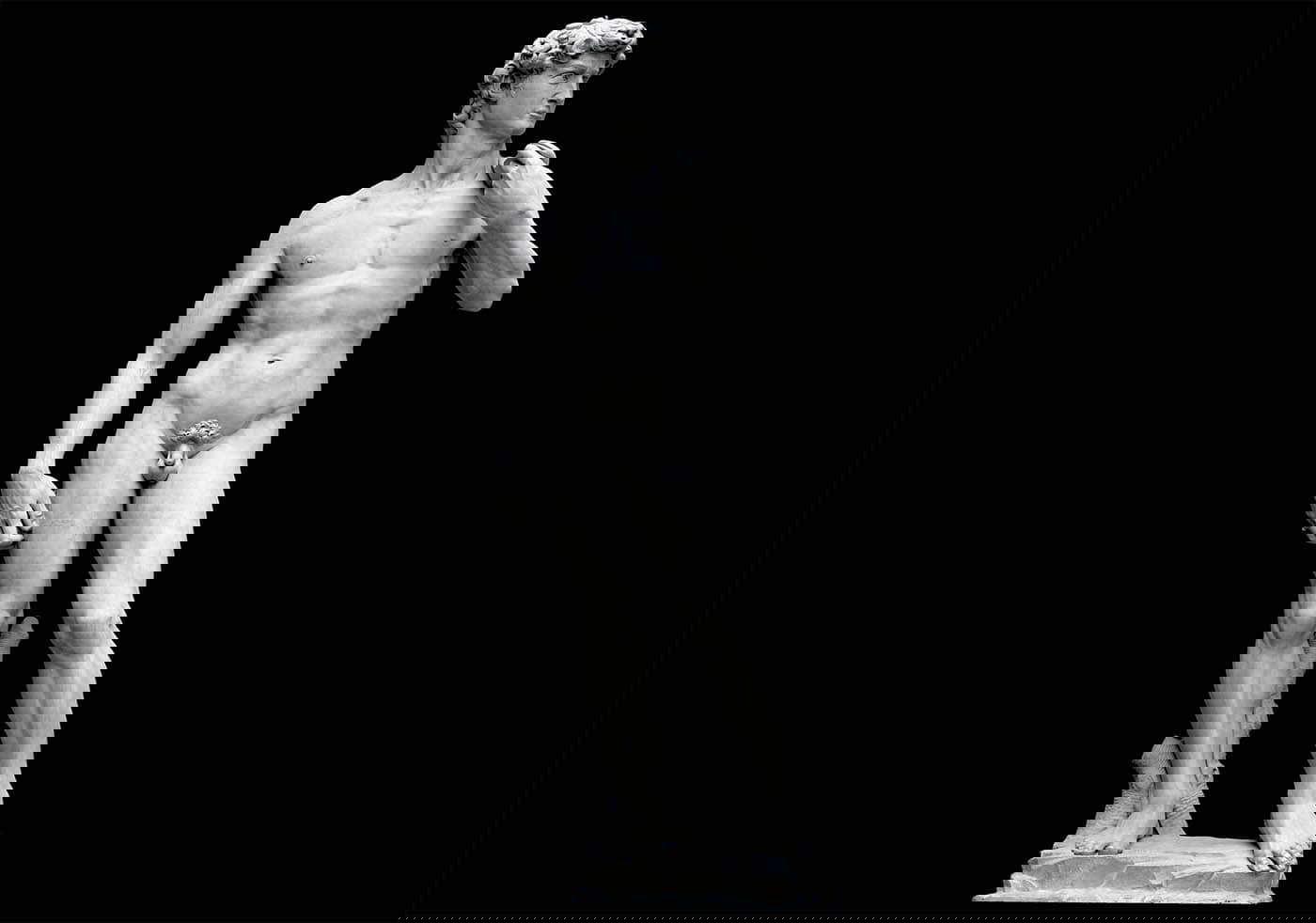
In 2010, a legal boxing commenced between the city of Florence and the nation of Italy over who really owned David. The statue has resided within the Galleria dell'Accademia, a state-run institution, since 1873, where it has been maintained, protected and restored until now. Nevertheless, the statue was commissioned and made in and for the city of Florence, and the metropolis has maintained the statue in Piazza della Signoria for 500 years prior to its motion indoors. The dispute has yet to be resolved, leaving David betwixt the metropolis and the nation.

Past Charlotte DavisBA Art History Charlotte is a contributing writer from Portland, Oregon now based in London, England. I'one thousand an fine art historian with extensive noesis in art history, classics, ancient art and archaeology.
hodgescolooter1988.blogspot.com
Source: https://www.thecollector.com/10-facts-about-michelangelo-david-sculpture/
0 Response to "What Aspect of Renaissance Art Does Michelangelos David Portray"
ارسال یک نظر